Showing posts with label nonfiction. Show all posts

Saturday, October 1, 2011

There and Back Again: An Actor's Tale by Sean Astin


7 Stars (-2 for language)

Ok, maybe it's because Sam was my favorite character in Lord of the Rings but I really enjoyed this book. It's been sitting on my shelf for years and I finally read it. I thoroughly enjoyed the behind-the-scenes look not only at the making of the trilogy but of the workings of Hollywood as well (I can safely say that I will never be an actress, thank you very much). However, Astin's humor and his focus on family made this an enjoyable read.

Friday, March 4, 2011

The Pioneer Woman Cooks by Ree Drummond


7 Stars

So, surprisingly, I read this entire cookbook cover to cover. I can't say as that has ever been something I'd expect me to do, but Ree Drummond's outrageous sense of humor (not to mention her gorgeous photography of her rural home) kept me interested even through lists of ingredients. Drummond started out as a blogger and found such a positive response for her recipes listed there that she created this book. It isn't a book I could recommend to everyone as a COOKbook, as she has pretty much only "hearty" fair (read, meat and potatoes or lots of sugar and butter), but there were several recipes I'd like to try, and of the ones I DID try, all were keepers. It would be a GREAT cookbook for beginners, not only because it keeps the process interesting, but because Drummond photographs and explains EVERY step, making it very easy to follow even the more complex recipes. And, come on, any author that begins her acknowledgments page with, "I loved writing this cookbook. It made me happy. And chubby." is worth the read. Check it out! (Oh, and in case you are wondering, her cinnamon rolls are to DIE FOR. As in, even non-diabetics may be sent into a sugar coma by eating just one. But, YUM.)

Tuesday, February 8, 2011

The Well-Worn Interior by Robin Forster and Tim Whittaker

First off, I just have to say--HOORAY, that other people have written! :D Thanks, guys. And, on to it...


7 Stars (-2 for Beginners)

This is a non-fiction read, that at first glance may look like a "how-to" for the Shabby Chic. I was very pleased to find that this wasn't what the book is at ALL. It is actually a very lovely look at past (think 1600s-1800s) home decor fashions and what these have deteriorated into. And, more importantly, why we should relish that decay rather than being so swift with the scrapers and paintbrushes. It was really a charming book. And it inspired me to find out more about my own (1940s circa) home and restore some of its roots a little. I gave it a minus 2 for the "beginner", because if you are not interested in home decor, or decrepit old buildings, it would probably be a pretty uninteresting read. And since all of the pictures are of grand old houses in various states of disrepair, their brand of beauty is not for all (though I LOVED many of them).

Monday, January 17, 2011

The Devil and Sherlock Holmes: Tales of Murder, Madness, and Obsession by: David Grann

7 stars- 3 for language = 4 stars

This book is a collection of 12 truly unique articles by New Yorker staff writer David Grann. They are strange, creepy, interesting, and at times disturbing. Here is a sample of a few of the articles.

- A real life murder mystery involving a scholar who studied Sir Arthur Conan Doyle and Sherlock Holmes.

-My personal favorite, a con man pretends to be a family's missing child. A suspicious personal investigator discovers that the family may have killed their 'missing' child and know full well the the con man isn't their child. Who has really been conned?

-A firefighter loses his memory shortly after the events of 9/11and tries to retrace his steps, struggling to learn whether he was a hero or a coward when the towers fell.

-A man convicted in what seems to be a clear cut arson case is revealed to be innocent after certain advancements in science.

-The world's largest prison gang is investigated and disturbing insights are revealed.

-And more!

The stories range from real life mysteries to strange events to bios of obsessive people. All are nonfiction and all are very interesting. I must say that I enjoyed the articles in this book a great deal. Unfortunately, the language is simply terrible. The author himself doesn't use any bad language but he quotes many gangsters, criminals, and tough characters that can swear up a storm. Although I found it very interesting, I can't recommend it to anyone who dislikes bad language in books.

Wednesday, January 12, 2011

A Circle of Quiet by Madeleine L'Engle


9 Stars

"Every so often I need out--away from all these people I love most in the world--in order to regain a sense of proportion. My special place is a small brook in a green glade, a circle of quiet from which there is no visible sign of human beings. . . . [there] I move slowly into a kind of peace that is indeed marvelous, annihilating all that's made to a green thought in a green shade." (Taken from the text.)

I have a hard time classifying this as a biography--it is a series of sketches from Madeleine L'Engle's life. But, she explores so much more than her own life here that "biography" just doesn't quite cut it. She weaves in stories from all ages in a seemingly random pattern and then ties them all in to a gorgeous tapestry of words. A consummate author giving guidance and advice from her own world to the budding writer, the artist within. This is one of the best books I have read in a very long time.

Warning: "A Circle of Quiet" is not for the faint of heart. Though the cover looks placid, L'Engle runs through some fairly deep and turbulent topics. She writes about things that are not easy to talk and think about--things that often don't have cut and dry answers. And, while she covers all these topics with the same practical, everyday wisdom, they are only easy to bear reading about because you can feel the strength of her own humanity with you on your trip through them.

Sunday, December 12, 2010

Funny In Farsi by: Firoozeh Dumas

7 stars

Funny In Farsi is a memoir of an Iranian girl growing up in America. Firoozeh Dumas first came to the U.S. from Iran in the early '70s when her father was sent to California on a two-year contract from the National Iranian Oil Company. Her family soon discovered that his presumed skill in English was basically limited to "vectors, surface tension and fluid mechanics." In short, humorous vignettes, the author recounts their resulting difficulties and Americans' almost total ignorance of Iran, illustrating the kindness of people and her father's absolute love of this country. - From Amazon.com

I must say that I enjoyed this book. I was led in a playful way through some of the culture of Iran, laughing as I went. Firoozeh amusingly describes the hilarity that ensues when as two very different cultures clash. The easy pace and friendly tone made it a quick and easy read, and one I would recommend to those looking for a little humor or a peek into Iranian culture. My only possible complaint was that in seemed a little rushed at times. I would have liked to have read a little more.

Thursday, November 4, 2010

Life of a Colossus by: Adrian Goldsworthy

8 stars

Life of a Colossus is a biography of Julius Caesar. Though I have not read any other biographies of Caesar, I am tempted to call it the authoritative biography. It chronicles everything we know about Caesar, from his early years on the run from the dictator Sulla to his conquests in Gaul and Britannia as a proconsul to the civil war against Pompey to his assassination at the hands of Brutus. In short, Caesar lived a very exciting life during an exciting time in history.

Adrian Goldsworthy manages a good balance storytelling and historical accuracy. He has no qualms admitting when our knowledge is limited or missing, but he doesn't bogged down in scholarly quagmires. Goldsworthy focuses on Caesar, but you will also learn a good deal about the Roman Republic in its last years, as well as several other famous Romans, including Pompey, Crassus Curio, Cicero, Cato, Mark Antony, Brutus, and Sulla. Though the book is long, it is well paced and there is always something interesting happening. I thoroughly enjoy it all, and often I found myself wishing I was a Roman aristocrat rubbing elbows with these men.

I would add a small warning. At a little over 500 pages of nonfiction, the book is not for the faint of heart. Those who love history, especially ancient history, will enjoy it, but it is surely not a causal reading.

Saturday, October 23, 2010

In Defense of Elitism by: William A. Henry III


3 Stars

I picked up In Defense of Elitism because it sounded like an interesting philosophical read. The basic premise is this: Those people who are more valuable to society deserve greater privileges and respect. In the past such value was measured by blood and lineage, but in modern America this can simply be those who contribute the most to society. The author does a good job of outlining this premise. I was hoping that he would offer multiple arguments to support this premise, as well as discuss multiple arguments against it, ideally offering counters to such arguments.

Instead, the author focuses on only one argument in favor of this premise: elitism works better than egalitarianism. To support this argument, Henry examines the state of the work force, school systems, culture, and other things. He paints the failings of all of these areas due to a leaning towards egalitarianism and away from elitism, and suggests that by focusing on more elite systems the failings would disappear.

Though it was not the book I had hoped to read, I have a different, rather larger problem with the book. All information and research contrary to his argument he assaults with a hefty sledgehammer of skepticism. He attacks any and every possible weakness, at times dismissing strong reasonable pieces of research. After he does this, he presents his own information, but does very little to support or defend it. He merely asserts his claims and assumes that we should accept it. As a result, I felt that he was being unfair to the opposition and overly generous to his own claims.

In addition to this, I felt that he was arguing for some unsavory things that didn't necessarily have all that much to do with the arguments concerning elitism and egalitarianism. I won't go into detail, but at times it felt more like a personal rant than anything else. As a result, I found the book quite disappointing, and I would not recommend it to anyone.

Friday, October 15, 2010

The Classics Reclassified by Richard Armour


7 stars

The Classics Reclassified is for those who hate classics. It is also for those who love classics. The Iliad, Julius Caesar, Ivanhoe, The Scarlet Letter, Moby Dick, Silas Marner, and David Copperfield all receive a humorous summary. Richard Armour's sharp wit spears the plot holes, the characters that don't make sense, the things that ought to have been left out, the excessive details, and everything else that your English teacher was too proud to point out.

Those of you who love the classics will enjoy a hearty chuckle. Those of you who hate the classics can laugh at their expense. Either way, laughter will ensue.

Monday, September 20, 2010

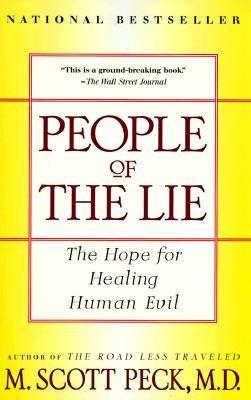
People of the Lie by: Morgan Scott Peck

5 stars

People of the Lie is a psychiatrist's attempt to fuse science and religion by explaining the phenomenon of evil people with psychiatry. In a sentence, it was an interesting read, but I believe he was ultimately wrong.

According to Peck, evil is basically a kind of disease: malignant narcissism. The evil person is one who refuses to submit one's will to a higher power, be it God or some other virtue or discipline. Believing they are right and refusing to accept otherwise, they force others to live according to their worldview. Because they believe they are right, they will lie to themselves and others in order to convince others of their virtue (hence the title of the book, People of the Lie).

While using psychiatry terms to describe evil can be useful, I think that equating evil with narcissism is a mistake. First and foremost, narcissism is sometimes a medical condition, and other times a choice. Evil doesn't work that way. Evil isn't a medical condition that afflicts people. Second, calling evil a disease possibly suggests a genetic element, which is just wrong. The dichotomy of good and evil isn't about one's genetic structure, nor should it be.

As I said before, People of the Lie was an interesting read, but he simply wasn't right. It was fairly well written. I feel that it did dip too far into the occult for a nonfiction book, but only occasionally.


Monday, August 30, 2010

October Sky, or Rocket Boys by Homer Hickam


10 stars

Summary: NASA engineer "Sonny" Homer Hickam accounts his childhood and high school years as he and a group of misfit boys follow their dreams to reach space and build amateur rockets against all odds.

Review: I absolutely loved this book. I couldn't put it down, even while we were on our vacation to Disneyland. Homer Hickam has such an honest and humorous writing style that I laughed out loud several times. I even have to say that I got a little teary in some sections. It had a more novel-like feel rather than an autobiography. It was also one of those feel-good books that you put come away from feeling like you are a better person for reading. Like Homer Hickam, you come away from the experience feeling like you are empowered to do anything if you work at it. A thoroughly enjoyable read.

-Amy

Monday, August 23, 2010

The Tao Speaks Adapted & Illustrated By Tsai Chih Chung


Expert Rating: 6 stars

Newcomer Rating: 3 stars

Before I review this book, I’d like to take a step back so everybody is on the same page. Taoism is a Chinese philosophical and religious school of thought founded by the legendary (and possibly fictitious!) figure Lao Tzu. Lao Tzu wrote a book called the Tao Te Ching. The Tao Te Ching argues for a certain way of living, which includes following the Tao, refraining from wealth or honor, and living a simple life.

That said, The Tao Speaks is a book that describes and explains the principles contained within the Tao Te Ching. It is not really intended as an introduction to Taoism, but instead a further explanation for those who have already read the Tao Te Ching. Therefore, I wouldn't recommend it to newcomers. For those interested, I do have a couple of books that would do a fine job of introducing you to Taoist philosophy.

For those of you who know a little about Taoism, let me say a few things more about this book. The Tao Speaks does offer a pleasant romp through Taoist thought. Both the illustrations and the text are simple, minimal, and beautiful. The text will not be hard to understand, but so much meaning is packed into so few words it might be hard to comprehend. (Did that make sense?) While enjoyable, I felt that The Tao Speaks only offers explanation on the most traditional understanding of Tao Te Ching, rather than a new or unique interpretation. Therefore, you won't learn a whole lot of information. Truth be told, most everything from The Tao Speaks could be gleaned from other sources, if you knew where to look. Therefore, I would say that the The Tao Speaks is a unique artist experience, but as academically edifying as other texts.

In conclusion, The Tao Speaks isn't for newcomers, but is a fair book for those who already know a thing or two about Taoism.

Thursday, August 19, 2010

Mao and Me by Chen Jiang Hong

6 Stars

Mao and Me
is a very short but intriguing read. Less than a hundred pages and illustrated in a way reminiscent of ancient Chinese art, it doesn't take more than an afternoon to read. It offers a small autobiographical glimpse into a boy growing up during Mao's declared cultural revolution. Since I am young and foolish, I don't know anything about China's recent history. This story offers a story both happy and sad. One gets to hear a story about a boy who grew up living simply but happily with his family. One also hears about book burnings, forced public disgraces, and a harsh government that forces people to live a certain way.

I'm sure that those who know about China's history will learn very little new information. I'm also sure that those like me, with little knowledge on this subject, will not gain a full picture of what happened. However, Mao and Me does provide a little look into a very foreign world. It was enough to pique my curiosity to look further, and it could do the same for you.

The Professor and the Madman by Simon Winchester


I thought I would repost the book reviews I did on my family blog. So Professor and the Madman, Mao and Me, and Winnie the Pooh are from that site.

7 Stars

How to make the first complete English dictionary:

Step One: Read all English literature.

Step Two: Copy down every single word.

Step Three: For each word, write a clear definition for every use. Track the word's history. Illustrate each use with a quote from literature. If possible, find the earliest use of the word.

Step Four: Alphabetize and organize all words. Put into typeset. (Backwards and reverse order)

As per the Admiral's orders, I am now reviewing the books I read. I finished The Professor and the Madman about a week ago. Although the making of the Oxford English Dictionary (OED) may not sound like an interesting reading topic, I thoroughly enjoyed it. In the world of the internet, computers, laser printers, and readily available dictionaries, it is hard to imagine the sheer amount of work required to create the world's first complete dictionary. As you'll learn from this book, it took thousands of contributors and nearly a century of work to make it happen. Dedicated volunteers from all over America and English read, wrote, and sent words to a single address. There, a full time staff was dedicated solely to struggling to control the madness of thousands of words being sent daily. The paper alone weighed in the tons, and had to be kept on a specially reinforced floor.

Added this amazing story of the OED is one more strange fact: one of the greatest contributors to the OED was a man who was completely and incurably insane. Articulate, educated, helpful, but insane.

In short, The Professor and the Madman provides a vivid and interesting account of a unique piece of history. Fittingly for a book about a dictionary, the vocabulary was challenging and the tone was educated. I was rarely bored, and I was always curious about what was going to happen next. The final chapter raises some interesting questions that make you think. I would recommend it for anyone looking for some interesting nonfiction.