Wednesday, October 6, 2010

A few children's reads...

So, for a slight change of pace, I decided I wanted to add a brief list of a few favorite picture books. I like some more than others, but I'd say they all fall within the 8-10 Stars range. They are all different styles and genres and are only really related insofar as they are some favorites of mine, sorry.


The Dot by Peter H. Reynolds:

I have loved Peter H. Reynolds' loose-style illustrations ever since I've known of him, but this book especially holds a place in my heart. It's a book every artist really ought to own. Sarah, this means you. If you don't have it already, you need to. ;D (And, I have to add that the first time I read this book, it was a Spanish translation called, "El Punto", which actually I may have liked even more, since that title added some interesting double meaning to the whole...)


Ms. Rubinstein's Beauty by Pep Montserrat:

This has been a favorite ever since discovering it a couple of years ago. It is the only work so far by this author illustrator, but it's a great one. For a far more poetic (albeit a bit of a plot spoiling--read it AFTER you read the book, I'm telling you!!!) review than I can give, please visit:
http://fusenumber8.blogspot.com/2007/02/review-of-day-ms-rubinsteins-beauty.html


City Dog, Country Frog by Mo Willems:

The gorgeous pictures by Jon J Muth are what attracted me to this book to begin with, but it is as beautifully written as illustrated. Poignant, silly, sweet, sad, and wonderful all rolled into one. And, did I mention the gorgeous pictures?


Fox in Socks by Dr. Seuss:

So, perhaps it is a tad cliché to include Dr. Seuss, but really, the guy was a genius. This is one that I don't remember reading as a child, but just might rank as my favorite of his books. It doesn't have the same depth of meaning as some of his others, but the alliterations and rhyming patterns are FAN. TAS. TIC. Not than anyone expected anything else.


Snow White illustrated by Trina Schart Hyman:

I mention the illustrator, not the author, because, truthfully I have never loved the tale of Snow White. It's really, very dark. This retelling is no exception as it sticks pretty close to the Grimm version. BUT. If you have never loved Snow White, either, this book might just change your mind. And all because of a person known as Trina Schart Hyman. Who I adore. I have never been disappointed in a book she's illustrated, because even if the book were completely terrible, her illustrations would make it all worth while. No, seriously. Check it out, and you will see exactly what I mean.


The Sleeping Beauty by Mercer Mayer:

I know, I know, another fairy tale with beautiful pictures. But, this one, I choose not just for the amazing illustrations, but because this is my very favorite re-telling of the tale of the Sleeping Beauty. Ever. And I've read a LOT of re-tellings. Mercer Mayer manages to add all sorts of interesting twists to the timeless tale while managing to be true to the story. It is a real classic. And, just so that you know, if you have a hard time finding it, that's because it's now out of print. And people like to steal the library's copies and take the hit in fines just to have a copy. Unfortunately for the rest of us, it really is that good.


The Giving Tree by Shel Silverstein:

This book makes me cry. It has some of Silverstein's typically funny poetry, but it is much deeper than many of his other, sillier reads. Plus, it's about a tree, and we all know what a tree-hugger I am. But, then, since my dad had this book around for as long as I can remember, maybe this book is WHY I'm a tree-hugger.


The Eleventh Hour by Graeme Base:

Those of you who have never read any of Graeme Base's books need to move it to the top of your to-do list. Especially if you love bright colors. Or puzzles. Or clever rhymes. Or intricate illustrations. Or well-thought out children's books. ... Yeah. Enough said.

Saturday, October 2, 2010

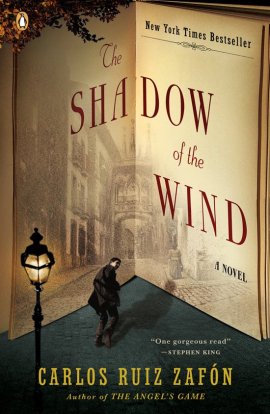
The Shadow of the Wind by Carlos Ruiz Zafón


4 Stars -3 for content (Yes, meaning it actually gets only 1 Star...)

"The novel, set in post–Spanish Civil War Barcelona, concerns a young boy, Daniel. Just after the war, Daniel's father takes him to the secret Cemetery of Forgotten Books, a huge library of old, forgotten titles lovingly preserved by a select few initiates. According to tradition, everyone initiated to this secret place is allowed to take one book from it, and must protect it for life. Daniel selects a book called The Shadow of the Wind by Julián Carax. That night he takes the book home and reads it, completely engrossed. Daniel then attempts to look for other books by this unknown author, but can find none. All he comes across are stories of a strange man – calling himself Laín Coubert, after a character in the book who happens to be the Devil – who has been seeking out Carax's books for decades, buying them all and burning them." (Taken from wikipedia.)

I'm only posting this, because based on the synopsis you might actually be tempted to read this book (the Cemetery of Forgotten Books, a mysterious book character burning a certain author's life's work, unusual setting, etc.). It starts out with so much promise! Ruiz' writing style is very lyrical and beautiful, and in the beginning there are lots of interesting and poignant interactions between Daniel and his widowed father. It carries on in this lovely way for about 60 or 70 pages and then, WHAM! Random sex scene. And then lots of garbage-y suggestive language for pretty much the rest of the book. :( This book is about 1/5 "Great Expectations", 1/5 "The Historian" (by Elizabeth Kostova), and, unfortunately about 3/5 parts smutty and salacious talk, gritty encounters, and people being absolutely horrible to one another. Boo. I hate when a very gifted author gives in to the temptation to make his book more "exciting" by adding a lot of unrealistically grimy atmosphere and language. I find it very difficult to believe that the vast majority of Spaniards in the 50s had such horrible marriages, and I scoff at the apparent take-home message that sexual intimacy is very rarely a good thing and that only when it's between young, unmarried, and inexperienced individuals. Again, boo. I have to admit that I did not read the whole book, but because of Ruiz' compelling storytelling, I skimmed about the last half of the book to find out the answers to the mysteries presented. An interesting plot-line, unique European setting, occasional flashes of hope and genuine human emotion, and an intriguing search for answers are, unfortunately, not enough to save this dark tale from the smelly pit into which the author has chosen to cast it.

Monday, September 20, 2010

The Island of Dr. Moreau by H.G. Wells

6 stars

The Island of Dr. Moreau is stereotypical Wells. For those who haven't read any H.G. Wells, he is famous for science fiction novels such as The Time Machine, War of the Worlds, and The Invisible Man. All of Wells' novels that I've read have had a similar theme- the degeneration of man due to science. The Island of Dr. Moreau is no exception- the main character is trapped on an island with the amoral scientist Dr. Moreau, who creates human-like beings out of animals.

The Island of Dr. Moreau is probably the grossest Wells novel that I've read, and therefore I wouldn't really recommend it to someone who wanted to read a science fiction book. However, if you like the amoral mad scientist theme, or you like H.G. Wells, go for it.

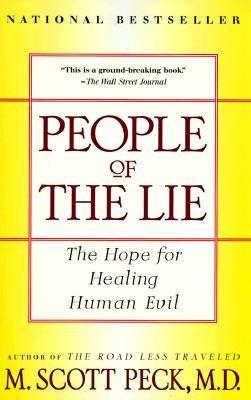
People of the Lie by: Morgan Scott Peck

5 stars

People of the Lie is a psychiatrist's attempt to fuse science and religion by explaining the phenomenon of evil people with psychiatry. In a sentence, it was an interesting read, but I believe he was ultimately wrong.

According to Peck, evil is basically a kind of disease: malignant narcissism. The evil person is one who refuses to submit one's will to a higher power, be it God or some other virtue or discipline. Believing they are right and refusing to accept otherwise, they force others to live according to their worldview. Because they believe they are right, they will lie to themselves and others in order to convince others of their virtue (hence the title of the book, People of the Lie).

While using psychiatry terms to describe evil can be useful, I think that equating evil with narcissism is a mistake. First and foremost, narcissism is sometimes a medical condition, and other times a choice. Evil doesn't work that way. Evil isn't a medical condition that afflicts people. Second, calling evil a disease possibly suggests a genetic element, which is just wrong. The dichotomy of good and evil isn't about one's genetic structure, nor should it be.

As I said before, People of the Lie was an interesting read, but he simply wasn't right. It was fairly well written. I feel that it did dip too far into the occult for a nonfiction book, but only occasionally.


Sunday, September 12, 2010

Secret Keeper by Mitali Perkins


7 Stars

"When her father loses his job and leaves India to look for work in America, Asha, her older sister, Reet, and their mother must wait with Baba's brother and his family...in Calcutta. Uncle is welcoming, but in a country steeped in tradition, the three women must abide by his decisions. ... Asha's only solace is her rooftop hide-away, where she pours her heart out in her diary, and where she begins a clandestine friendship with Jay Sen, the boy next door. ... Setting her novel in the mid-1970s, a time of political turmoil, Mitali Perkins probes the relationships between sisters, mothers and daughters, women and men. Secret Keeper tells of one girl's struggle, within the constraints of tradition, to establish her identity and claim her future." (Taken from the inside cover.)

I have to say that the biggest downside to this book was that it was only fairly written. I found Perkins' switching between the author's viewpoint, and Asha's first-person voice confusing. However, I found that I liked the book more than I normally do when I don't connect with the writing style. The characters were engaging, interesting, and believable, even though they are not deeply expounded upon. The setting, like Jane Austen's books, is mentioned only in direct relation to how it affects the characters (which, truthfully, isn't much), but I found that this added to the realism of Asha as a young woman. (I mean, what 16-year-old is really THAT affected by politics in their everyday life?) The book was also surprisingly poignant. It manages to explore some levels of social acceptance and age-old parent/child drama without making any one thing or person "to blame." You come away a little saddened by the plight of people within a culture that is so rigid in its socially acceptable norms, but still hopeful because the characters have managed to show respect and real love for each other without flouting generations of tradition. It was a surprisingly deep read, despite Perkins somewhat inexpert style.

Friday, September 3, 2010

The Curious Incident of the Dog in the Night-Time by Mark Haddon


4 Stars

Summary: Despite his overwhelming fear of interacting with people, Christopher, a mathematically gifted, autistic fifteen-year-old boy, decides to investigate the murder of a neighbor's dog and uncovers secret information about his mother. (taken from this inside cover)

Review:

This was a very insightful look into the mind of an autistic child, which is completely new to me. It was fascinating to see how he processed information and what seemed like little issues were drastically huge issues to him (for example, he hated the color yellow and could not touch it because it made him feel sick). There was also some subtle humor in the dry comments and observations. I did enjoy the mathematical aspects. I always remember Stephen Hawkings when he said that mathematicians see the world completely differently from non-mathematicians, and Christopher's comments reminded me of that. However, to me I just found the theology and the plot too depressing.

-Amy

Thursday, September 2, 2010

Going Postal By Terry Pratchett

8 stars

Summary from Amazon.com:
Soon after Moist von Lipwig barely avoids hanging, Lord Havelock Vetinari, the despotic but pretty cool ruler of Ankh-Morpork, makes him a job offer he can't refuse—postmaster general of the Ankh-Morpork Post Office. The post office hasn't been open for 20 years since the advent of the Internet-like clacks communication system. Moist's first impulse is to try to escape, but Mr. Pump, his golem parole officer, quickly catches him. Moist must then deal with the musty mounds of undelivered mail that fill every room of the decaying Post Office building maintained by the ancient Junior Postman Groat and his callow assistant, Apprentice Postman Stanley. Readers will cheer Moist on as he eventually finds himself in a race with the dysfunctional clacks system to see whose message can be delivered first.

Going Postal is but one of the many books written by Terry Pratchett, who is my favorite fiction author of all time. Pratchett is a hilarious writer whose books contain many subtle and not-so-subtle parallels of the real world. Within the humor you will find thoughtful critiques and dilemmas about some aspect of the real world. All of his books are intended to make you laugh, and as you laugh you think. I am always in awe of Pratchett's ability to do both at the same time.

I would say that Going Postal is probably in the high middle range of Pratchett's writing. If you haven't read any of Pratchett's books, Going Postal is an excellent place to enter. I own a copy (and many other Pratchett books) and would be happy to loan it out.